
At what point does an Amazon EC2 reserved instance become worth it?
If you purchase an Amazon EC2 reserved instance, you’ll pay a certain amount up front (pricing). If you don’t use the instance much, it will be more expensive per hour than a regular on-demand instance. E.g., if you paid $227.50 to reserve a small instance for a year but then only used it for a single day, you’d be paying almost $10/hr and it would obviously be much cheaper to just get an on-demand instance and pay just 8.5 cents per hour.
OTOH, if you ran a small instance for a year at the on-demand price, you’d pay $745 and it would obviously be cheaper to pay the up-front reservation price ($227.50) plus a year of the low per-hour pricing (365 * 24 * $0.03), or $490.
So for how long do you have to run an instance in order for it to be cheaper to pay for a reserved instance? (Note that I’m ignoring the time value of money, what you might do with the up-front money in the meantime if you didn’t give it to Amazon in advance, etc.)
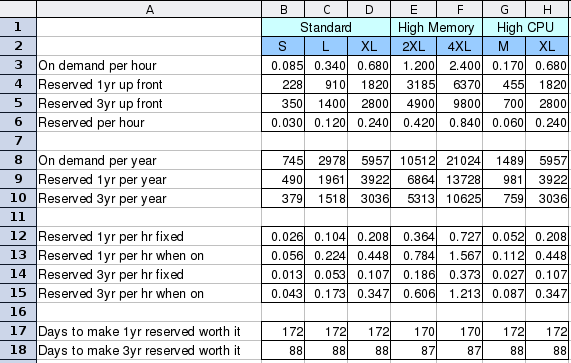
The answer is pretty simple: for a one-year reservation you need to run the instance for about 6 months to make it worthwhile. For a three-year reservation you need to run the instance for at least 3 months per year, on average.
Here’s a fragment from a simple spreadsheet I made, based on the US N. Virginia prices:
You can follow any responses to this entry through the RSS 2.0 feed. Both comments and pings are currently closed.
January 8th, 2010 at 12:19 pm
Very nice, I've been going through similar calculations on what the best usage pattern is for our distributed storage grid on AWS and other systems. This post has reminded me that when I'm reasonably well done, I should publish them as they may be a valuable use-case to someone else.
January 8th, 2010 at 7:19 pm
Very nice, I've been going through similar calculations on what the best usage pattern is for our distributed storage grid on AWS and other systems. This post has reminded me that when I'm reasonably well done, I should publish them as they may be a valuable use-case to someone else.